Projects / Multi-agent assistant
Multi-agent conversational assistant
An LLM-based multi-agent system, built into PlanTEA-WM, that suggests routines tailored to the profile of each autistic person. The agents reason and look up data; the final decision always belongs to the person.
- My role
- Design and development of the system: agents, integration with PlanTEA-WM and observability dashboard
- Period
- February – August 2026, funded by the Santander research initiation scholarship (UCLM)
- Context
- Master's thesis in Artificial Intelligence (graded 9.5/10), at the CHICO research group
- Code
- Private project repositories
Demo

The video is in Spanish and loads from YouTube when you click. You can also watch it on YouTube.
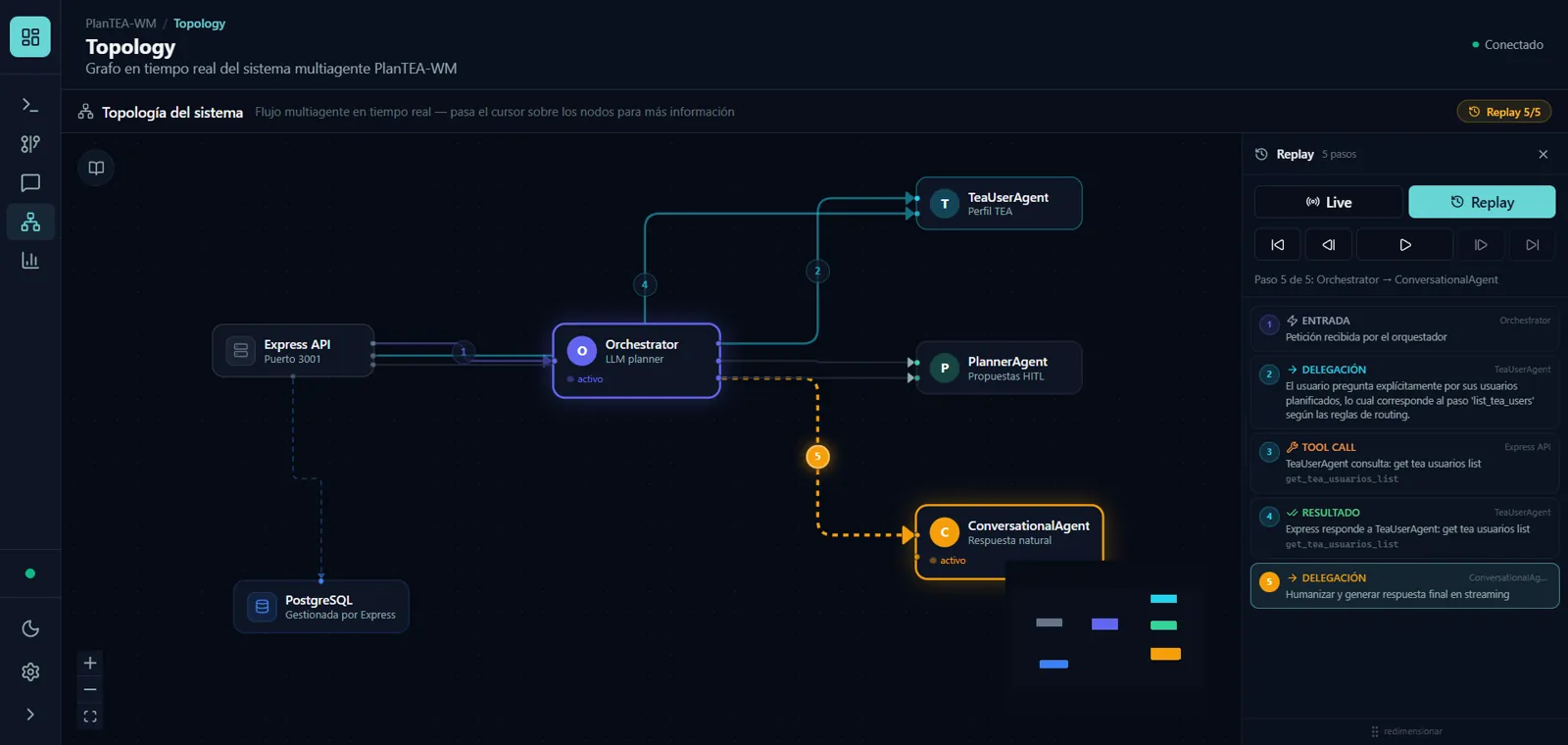
Screenshots and diagrams
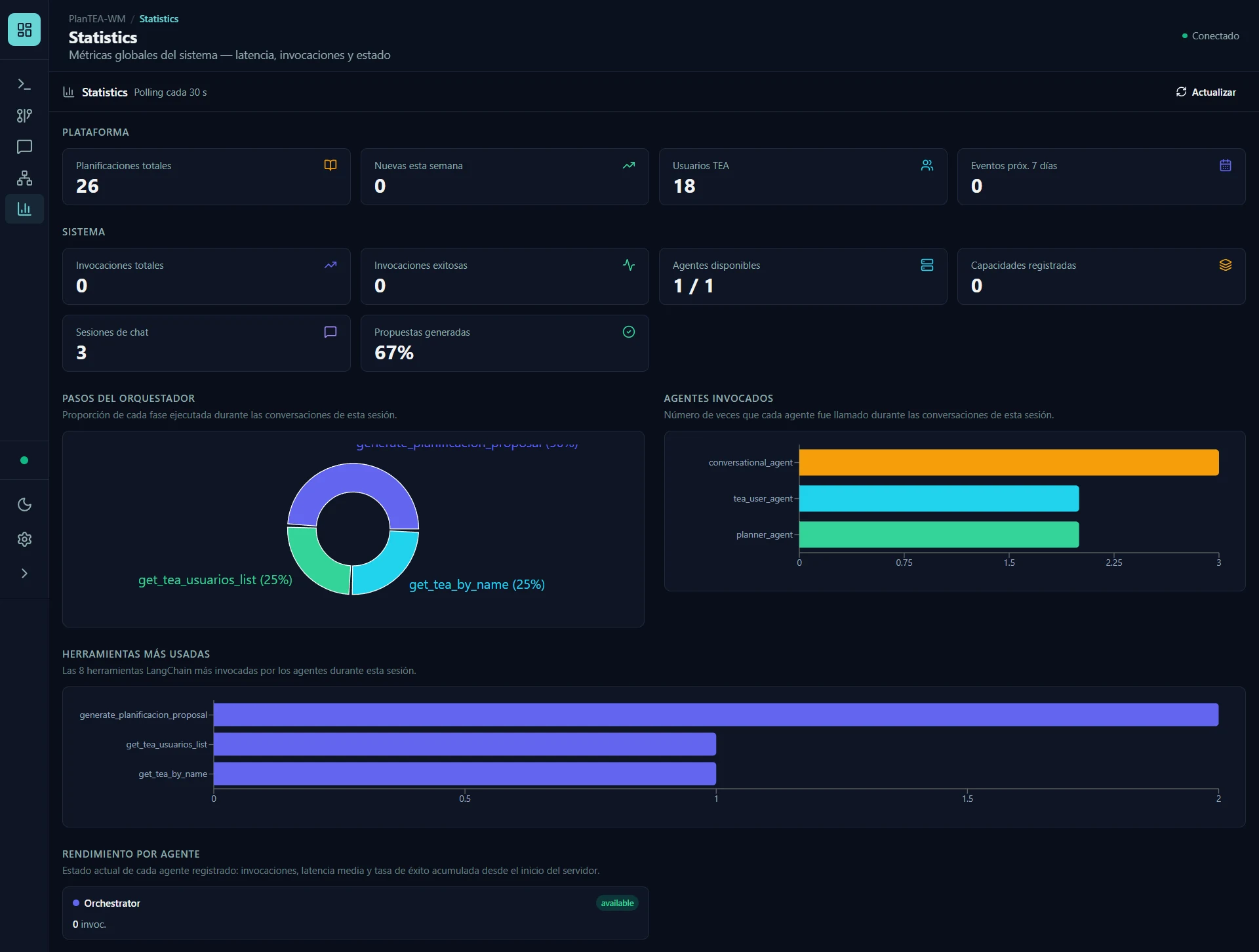
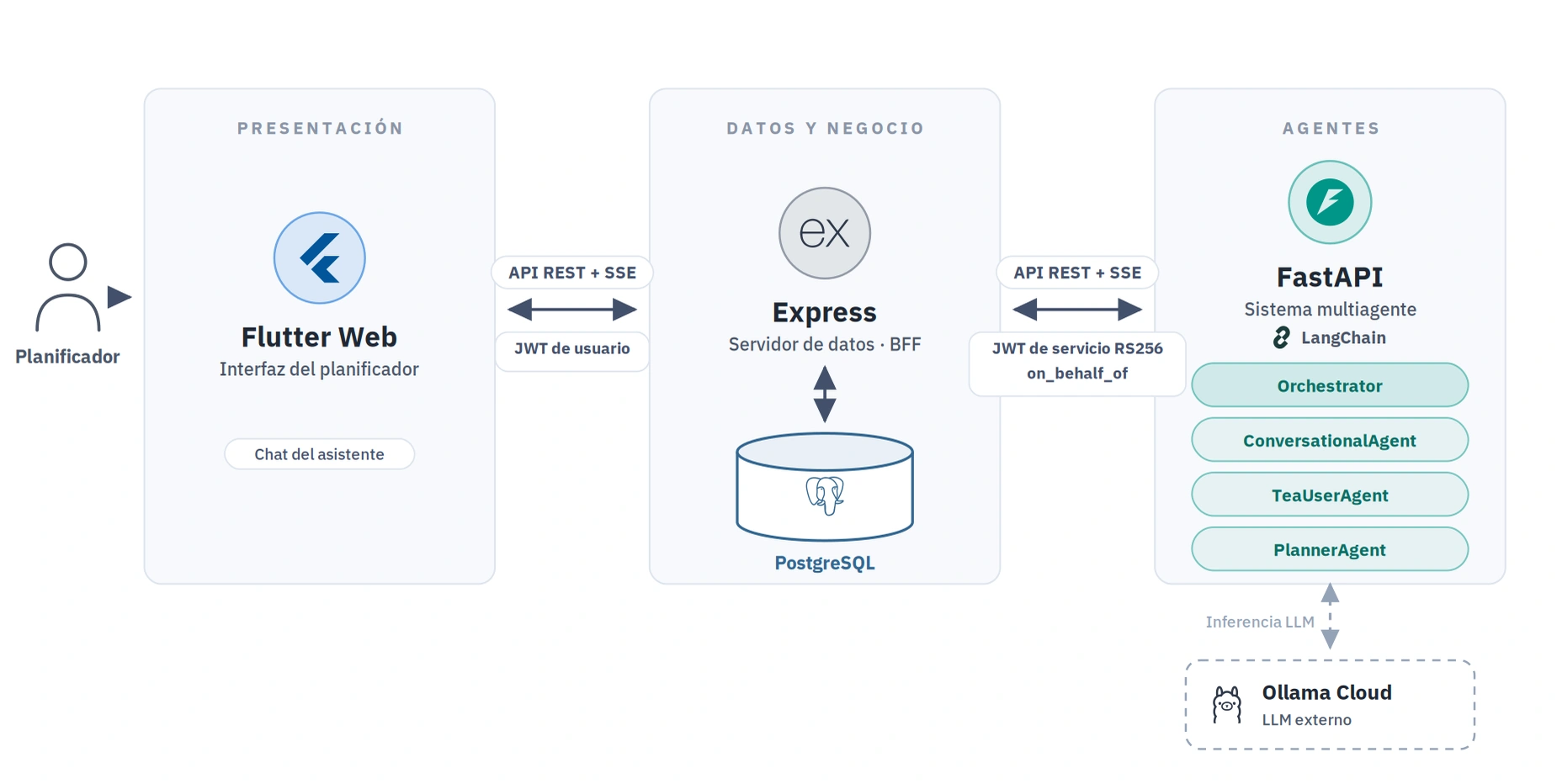
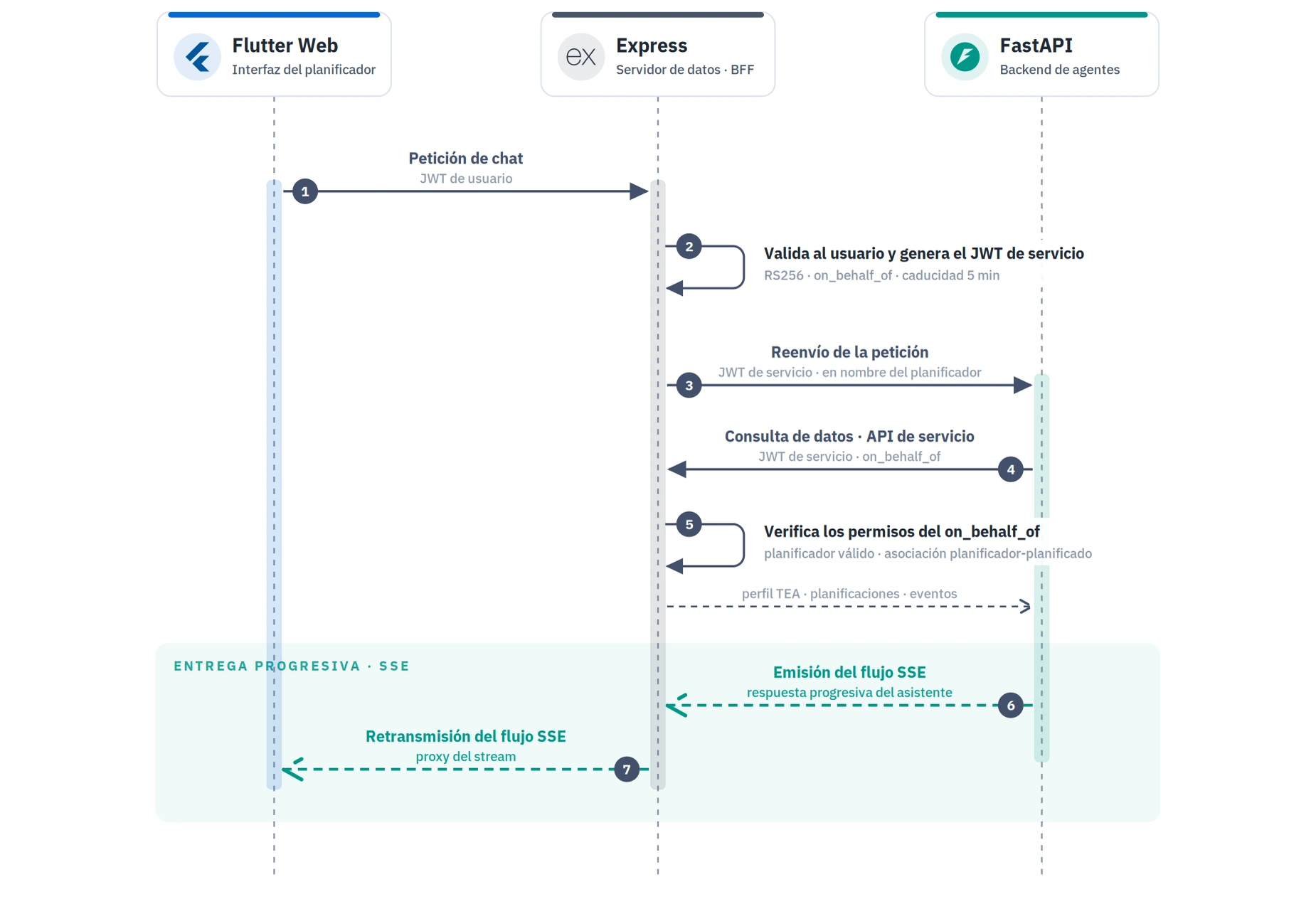
Images from my Master's thesis. Swipe or use the arrows; click an image to view it full screen.
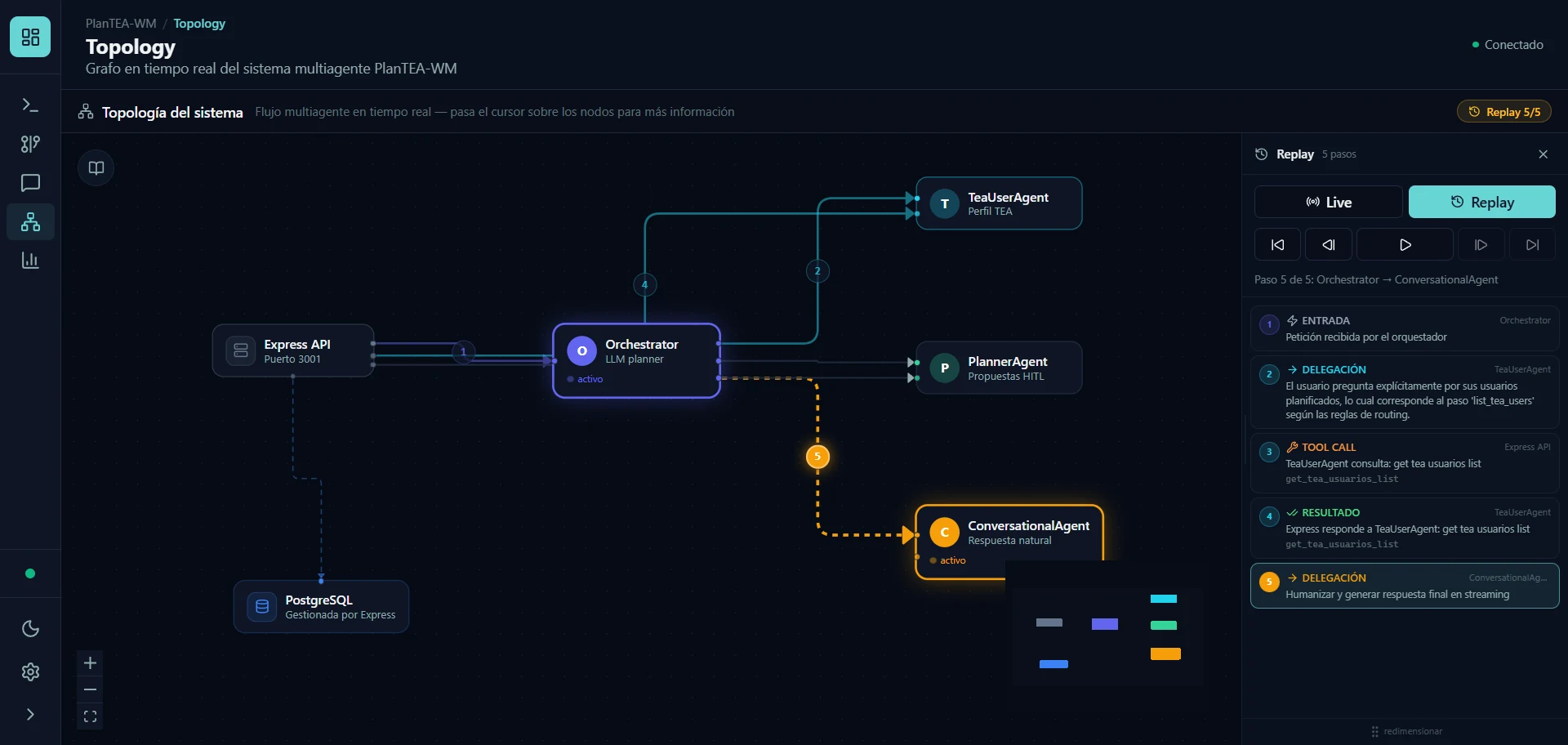
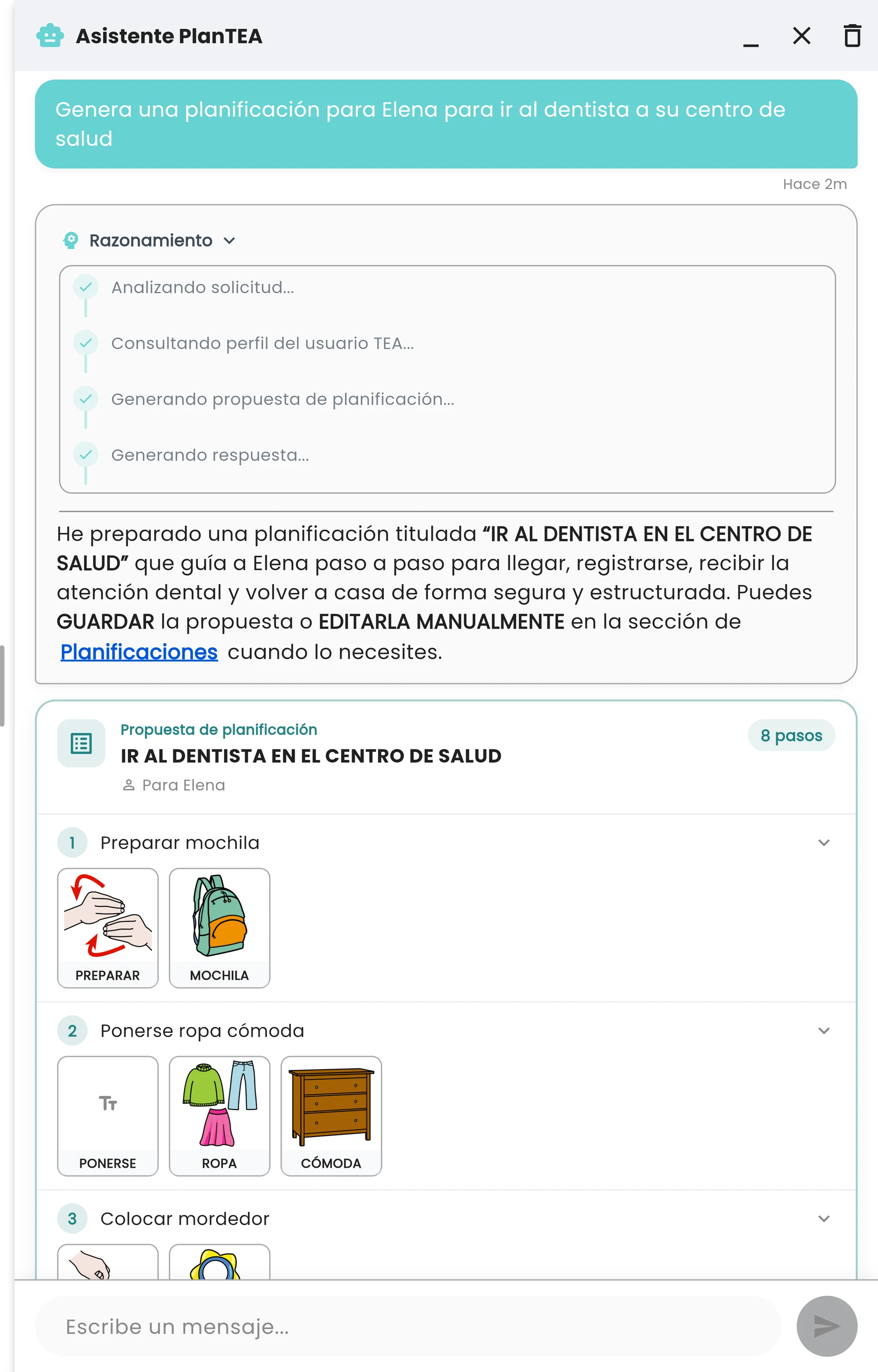
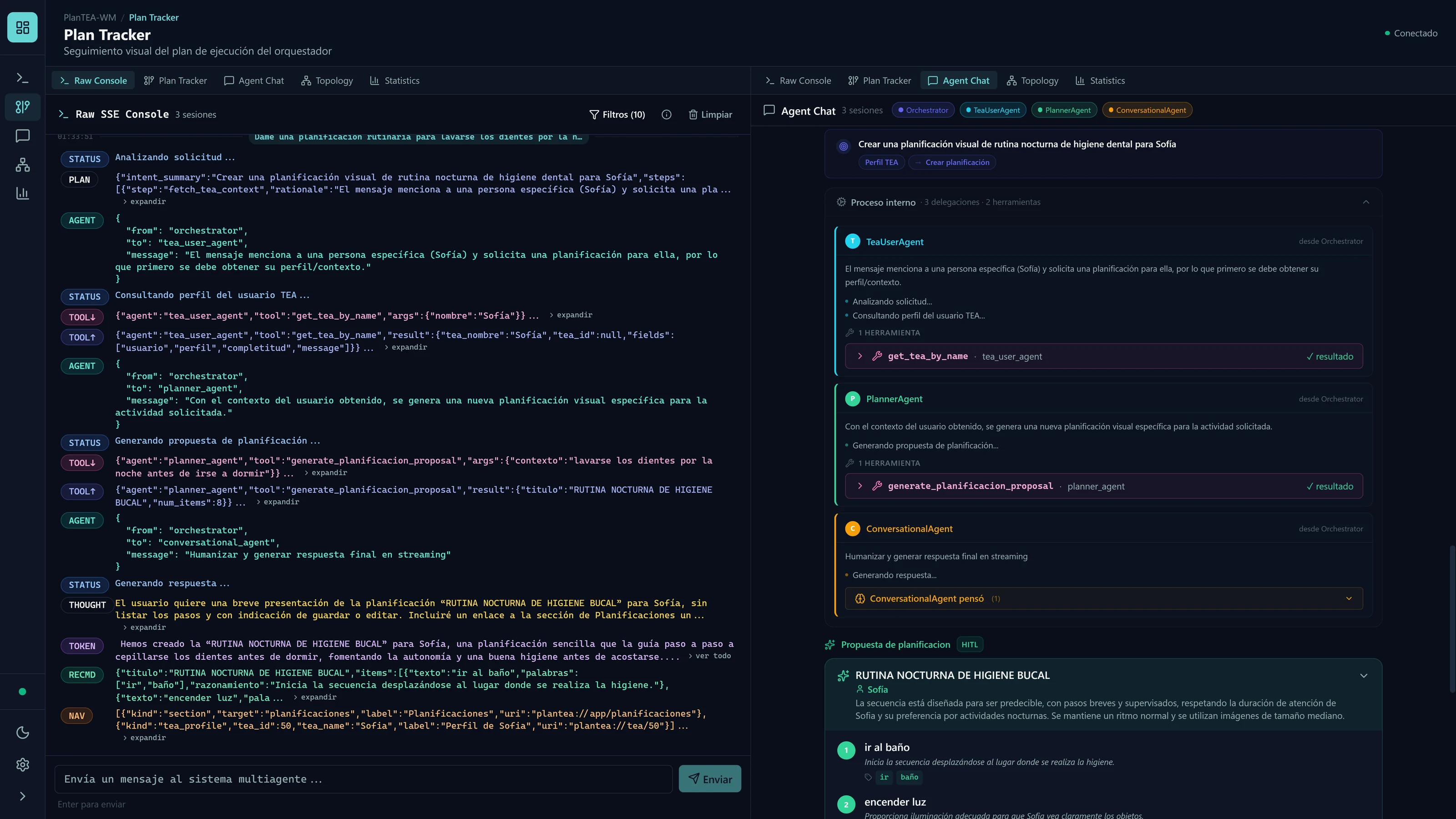
1 / 6
The problem
In PlanTEA-WM, families and professionals prepare pictogram routines for autistic people. My Master's thesis set out to build a conversational assistant that would help create those routines, tailored to each person's profile, to improve their autonomy.
Architecture
Press «Play a request» to see how a request travels through the system, just like the replay mode of the observability dashboard.
Clients
- PlanTEA-WMChat with the assistant and confirmation of the routine
- Observability dashboardReact 19 and TypeScript, real-time events
PlanTEA-WM backend
- Express as a BFFRS256 JWT with
on_behalf_ofand SSE streaming - Data APIRead-only for the agents
Agent service
- OrchestratorPython, FastAPI and LangChain, Plan-and-Execute strategy
- ConversationalAgent: the conversation
- TeaUserAgent: the profile of the autistic person
- PlannerAgent: the routine proposal
Model
- gpt-oss:120bServed on Ollama Cloud
Built for the thesisExternal service
How a request to the assistant flows through the system, step by step.
How a request flows
- The person planning writes their request in the PlanTEA-WM chat.
- The Express backend forwards it to the agent service with a signed JWT stating on whose behalf it acts.
- The orchestrator draws up a plan and carries it out by delegating to the agents, which look up the data with read-only operations.
- The proposal is streamed back over SSE, and the observability dashboard shows each step, each message and its latency.
- If the person confirms it, the plan is created with their own session, not with the agents' one.
What I did
- LLM-based multi-agent system in Python, FastAPI and LangChain: an orchestrator using a Plan-and-Execute strategy plans each request and delegates it to specialised agents that look up the user's profile and suggest personalised routines.
- Human-in-the-loop: the agent service's HTTP client only has read operations. The agents look up data and reason on their own, but a routine is only created when the person planning confirms it, and that request is made with their own session.
- Service-to-service security: the PlanTEA-WM Express backend acts as a BFF and calls the agent service with an RS256 JWT stating on behalf of which user it acts (
on_behalf_of). Responses are streamed over SSE. - Observability dashboard in React 19 and TypeScript (Vite, Zustand, Tailwind) with five views: step-by-step execution plan, conversation between agents, topology as an interactive graph with a replay mode, SSE event console, and latency and performance statistics per agent (Recharts).
- Testing with pytest and synthetic natural-language understanding cases, plus an audit with ALTAI, the European Commission's Assessment List for Trustworthy AI.
- Fuzzy inference proof of concept (Mamdani, scikit-fuzzy) to recommend the complexity of routines from two profile fields: attention span and tolerance to change.
The fuzzy inference is a design proposal developed in a separate notebook: it is not integrated into the prototype.
Technologies
- AgentsPython, FastAPI, LangChain, Pydantic
- Modelgpt-oss:120b on Ollama Cloud
- IntegrationNode.js and Express (BFF), RS256 JWT, Server-Sent Events
- DashboardReact 19, TypeScript, Vite, Zustand, Tailwind CSS, Recharts
- Testingpytest, synthetic cases, ALTAI
- Fuzzy logicscikit-fuzzy (proof of concept)
Results
- Master's thesis: 9.5/10Master's Degree in Artificial Intelligence, with an average grade of 9.18/10.
- 2nd Furious Koalas AwardTuring Machine Awards (6th edition, School of Computer Science, UCLM, 2026) for the best Bachelor's or Master's thesis, for the quality of the technical architecture design and source code.
- Working prototypeBuilt into PlanTEA-WM and shown in the demo video.
- Trustworthy AIReviewed with the ALTAI list and with human oversight of every routine that gets created.